NEW – AVAILABLE NOW
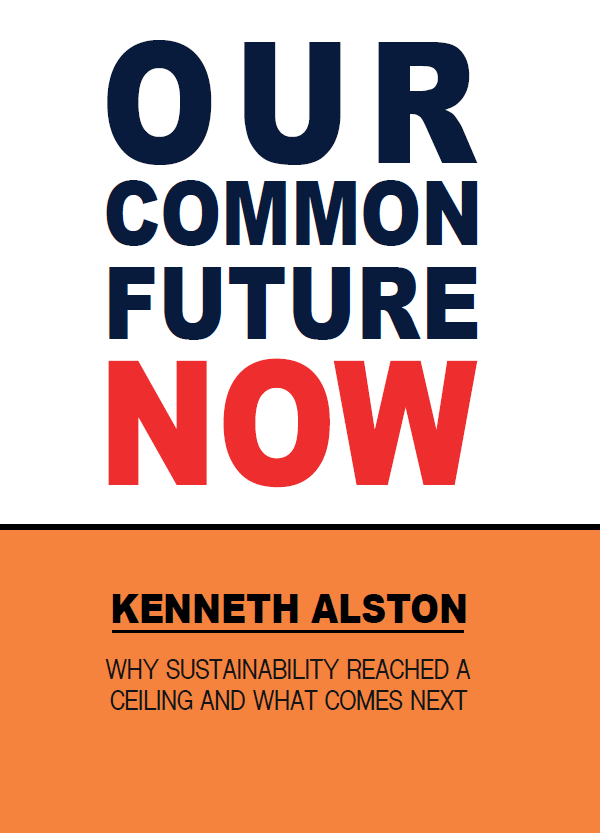
Our Common Future – Now
Why, after nearly forty years of serious effort, does real sustainability transformation remain so elusive?
A forty-year inquiry into the assumptions that shaped sustainability — and what we may have missed along the way.
Forty Years of Sustainability.
Why Are We Still Asking the Same Questions?
For nearly four decades, intelligent, committed people have worked to make business, industry and society more sustainable.
Companies have created strategies. Governments have established targets. New frameworks, standards, metrics and entire professions have emerged.
There has been no shortage of activity.
And yet many of the conditions required to sustain life continue to deteriorate.
So I found myself returning to a question that had become increasingly difficult to ignore:
Why?
Not who should we blame.
Not who hasn’t tried hard enough.
But whether something deeper has been shaping the decisions we’ve made all along.
So I went back to the beginning.
In 1987, the World Commission on Environment and Development published Our Common Future.
Most people know it through one sentence:
“Development that meets the needs of the present without compromising the ability of future generations to meet their own needs.”
It became one of the most frequently repeated definitions in sustainability.
Except it isn’t a definition of sustainability.
It is a definition of sustainable development.
And it appears within a report of more than 300 pages containing ideas, qualifications and relationships that could never be captured by a single sentence.
I had known the report for decades.
But when I went back and read it again—not looking for confirmation, but asking what we might have missed—I began seeing something different.
What if some of today’s conventional wisdom rests on ideas that became simplified as they were passed from one generation of practice to the next?
THE INQUIRY DEEPENS
Assume nothing. Confirm everything.
A strategist I work with once gave me a deceptively simple piece of advice:
Assume nothing. Confirm everything.
It stayed with me.
Because every field develops assumptions.
Ideas become accepted. Definitions become familiar. Models become standard. Eventually we stop asking where they came from—or whether they still describe what we think they describe.
Sustainability is no exception.
As I followed those assumptions backward, I began finding recurring patterns.
12 belief pairs.
And a 13th finding I didn’t expect.
Together, they began to reveal a ceiling—a boundary created not necessarily by a lack of effort, but by the assumptions through which the problem itself had been understood.
Our Common Future Now is the story of that inquiry.
NEW — AVAILABLE NOW
Our Common Future Now
What if the next step toward sustainability requires us to revisit what we think we already know?
Our Common Future Now looks back across nearly forty years of sustainability thinking and practice—not to dismiss what has been accomplished, but to ask what our experience can now teach us.
It revisits familiar definitions, models and assumptions and asks questions that are surprisingly easy to overlook:
What are we actually trying to sustain?
For how long?
What is the relationship between sustainability and sustainable development?
Is circularity necessarily sustainable?
And what can the structure of life itself teach us about continuity, compatibility and growth?
This is not an argument for abandoning sustainability.
It is an invitation to look again.
BUY OUR COMMON FUTURE NOW ON AMAZON
Then the inquiry took an unexpected turn.
While examining the assumptions embedded in decades of sustainability thinking, another question emerged.
Artificial intelligence is rapidly becoming part of how businesses research, analyze, recommend and decide.
But AI doesn’t begin with a blank sheet of paper.
It learns from what we have already written.
Our definitions.
Our frameworks.
Our conventional wisdom.
And our assumptions.
That changed the stakes.
Because the strategist’s advice—
Assume nothing. Confirm everything.
—was suddenly being reversed.
Increasingly:
We assume AI knows.
And we confirm nothing.
Which raised another question:
What happens when AI confidently reproduces assumptions we never stopped to examine ourselves?
NEW – AVAILABLE NOW
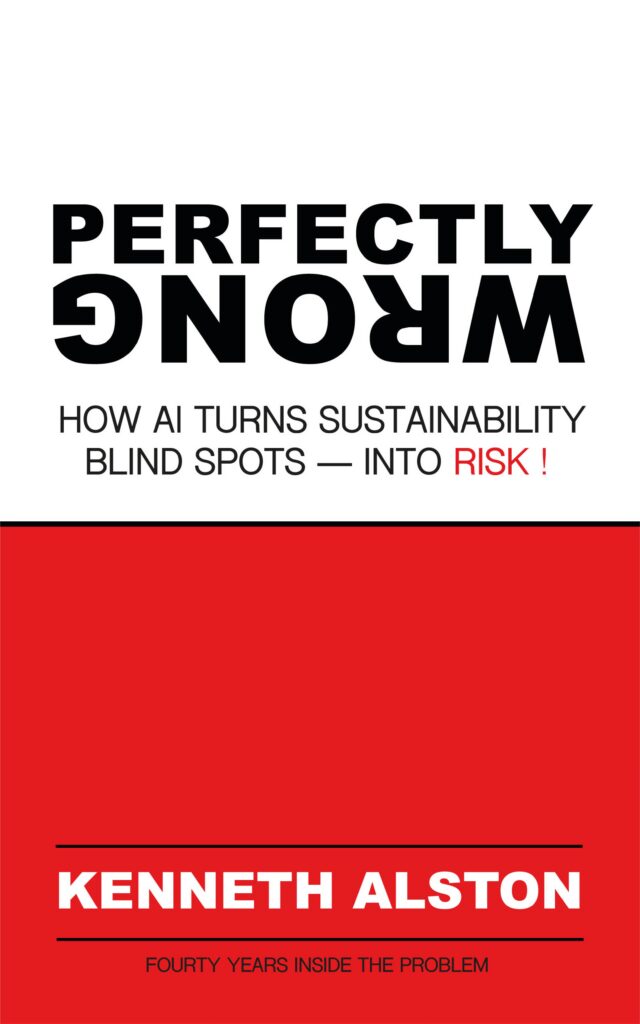
Perfectly Wrong
When the answer sounds right, looks right—and rests on the wrong assumptions.
Perfectly Wrong grew directly from the investigation behind Our Common Future Now.
If the first book asks what sustainability has inherited, the second asks what happens when AI inherits it next.
Artificial intelligence can produce answers that are articulate, confident and extraordinarily convincing.
But confidence is not verification.
And when an answer begins with an assumption nobody has questioned, AI can make the resulting error faster, more persuasive and easier to propagate.
BUY PERFECTLY WRONG ON AMAZON
The book didn’t begin as a conclusion.
It began as an inquiry.
As the fortieth anniversary of Our Common Future approached, I decided to look back.
Not to celebrate the past.
Not to criticize it.
But to investigate it.
The Inquiry follows that journey through a series of short essays and conversations examining sustainability, the Brundtland Report, business, circularity, assumptions and the questions that eventually led to these books.
You don’t have to agree with my conclusions.
The invitation is simply to join the inquiry.
ENTER THE INQUIRY
I’ve spent more than forty years inside this question.
My journey into sustainability didn’t begin with sustainability.
It began with chemistry, product development and the practical realities of making things.
Over the decades that followed, I worked inside corporations, helped establish one of the early corporate sustainability functions, worked internationally on sustainability and circularity, and spent seventeen years working alongside William McDonough and Michael Braungart.
I have watched sustainability evolve from an emerging concern into a global profession.
I was part of that evolution.
Which is precisely why I eventually felt compelled to go back and examine some of the ideas I had accepted along the way.
Our Common Future Now is not an outsider’s critique of sustainability.
It is the reflection of someone who has spent much of his working life trying to understand how business can prosper while contributing to—not undermining—the conditions that allow life to continue.
ABOUT KEN ALSTON
ALSO BY KEN ALSTON
Real Circularity
How to Be Circular and Sustainable in a Linear World
Written with Rachel S. Kan, Real Circularity explores the practical challenge of moving beyond linear business models while recognizing an important distinction:
Circular does not automatically mean sustainable.
The book represents an earlier stage of the journey that ultimately led to the questions explored in Our Common Future Now.
VIEW REAL CIRCULARITY ON AMAZON
Perhaps the next step begins by questioning what we think we already know.
Our Common Future Now
A forty-year inquiry into sustainability and the assumptions beneath it.
Perfectly Wrong
What happens when AI inherits those assumptions from us?